
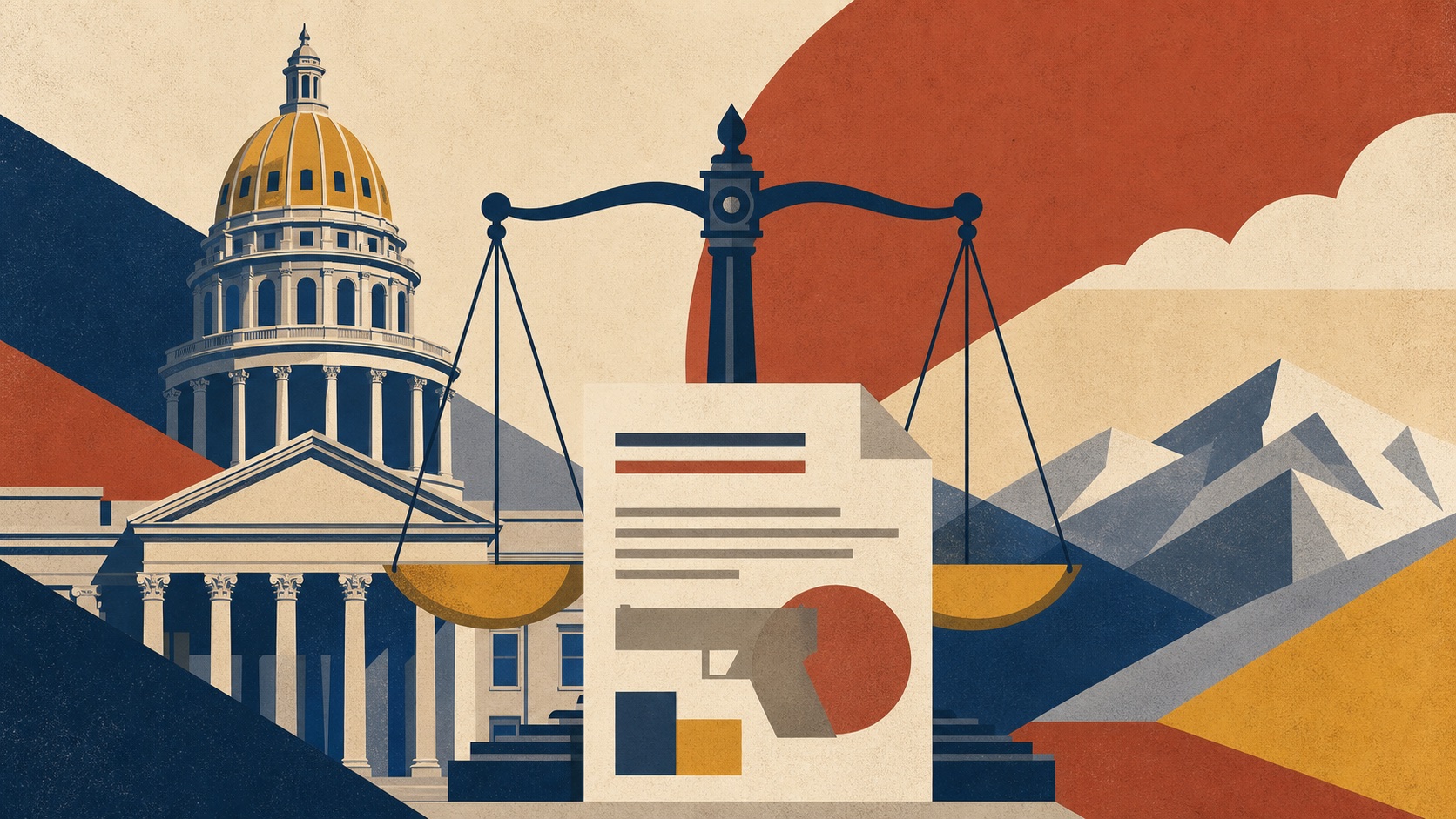
We wrote last month about the relationship between Colorado's pending firearms litigation and two Supreme Court cases that had not yet been scheduled. The Court has now set an argument date, and the federal government has filed a brief supporting the challengers.
The date
The Supreme Court will hear oral argument in the consolidated cases of Viramontes v. Cook County (challenging Cook County, Illinois's local ordinance) and Grant v. Higgins (challenging Connecticut's state-level ban) on Wednesday, December 2, 2026, at 10 a.m., with one hour set aside for argument. The accepted question concerns whether the Second and Fourteenth Amendments protect possession of semiautomatic rifles in common use for lawful purposes, including AR-15-style rifles. A decision is expected by the end of the Court's term, likely by late June 2027.
The Justice Department just took a side
As the cases were being briefed, DOJ filed an amicus brief supporting the challengers — signed by Solicitor General John Sauer along with Justice Department officials Harmeet Dhillon and Brett Shumate. The federal government argues that AR-15-style rifles are commonly possessed for lawful purposes and that categorical bans violate the Second Amendment. Separately, attorneys general from 27 states filed their own amicus brief supporting the challengers. These briefs present arguments to the Court; neither is a ruling.
Why this matters directly to Colorado, by name
The accepted question directly overlaps with challenges to bans on AR-15-style rifles, including Denver's local restrictions. A Supreme Court ruling may therefore have a major effect on the Denver portion of the pending Colorado litigation.
The connection to Colorado's 15-round magazine cap is less direct. The Supreme Court did not agree to decide whether magazine-capacity limits are constitutional. Its reasoning about common use and categorical bans could influence later magazine cases, but the decision will not necessarily resolve Colorado's magazine claim by itself.
Worth knowing, but not overreading
A DOJ amicus brief siding with the challengers, plus a brief from 27 state attorneys general, shows that the challengers have significant institutional support. It does not show how any justice will vote. Amicus briefs are arguments for the justices to consider, not votes already cast, and oral argument can reveal concerns that are not obvious from the written briefing.
Bottom line
Nothing changes today about Colorado's magazine cap or Denver's ordinance — both remain in effect. What's changed is that the Supreme Court's review of semiautomatic-rifle bans now has a firm argument date and a clearer picture of the federal government's position. The eventual ruling may directly shape challenges to rifle bans around the country and may provide reasoning that matters in other firearms cases, but its precise reach will depend on what the Court actually decides.
As always, we are not lawyers — just Colorado citizens trying to understand the rules, statutes, and court decisions and share what we learn. The information on this website is for general informational purposes only and does not constitute legal advice, nor does it create an attorney/client relationship. The accuracy, completeness, or currency of the content is not warranted. Your use of content on this website is at your own risk. Consult an attorney about your specific circumstances.